








How Thermal Imaging Cameras Improve Substation Maintenance Efficiency
Release Time 2026-07-13
Substations play a critical role in the safe and reliable transmission and distribution of electricity. Maintenance teams conduct daily inspections of transformers, circuit breakers, busbars, disconnect switches, insulators, cable connections, and various other electrical parts. As substations grow in scale and complexity, maintenance operations must become faster, more organized, and more efficient.
Thermal imaging cameras are no longer merely tools for detecting abnormal heat patterns or overheated components; they have become an essential part of modern maintenance workflows, enabling technicians to inspect more equipment, coordinate maintenance tasks, and make better operational decisions. Here's how thermal imaging improves maintenance efficiency in substations.
Complete More Inspections in Less Time
Traditional inspection workflows usually require technicians to stop at each piece of equipment to conduct visual inspections and record data using handheld measuring tools.
Using handheld thermal imaging cameras, inspection personnel can rapidly scan multiple pieces of equipment within a substation in a few seconds.
Instead of inspecting components one by one, they can quickly scan entire rows of equipment and immediately identify areas requiring special attention.
This streamlined inspection process enables maintenance teams to complete inspections of large substations in a single workday.
Easily Compare Similar Equipment
Many substations contain multiple transformers, switchgear units, circuit breakers, or cable connections that operate under similar conditions.
Thermal imaging makes it easy to compare.
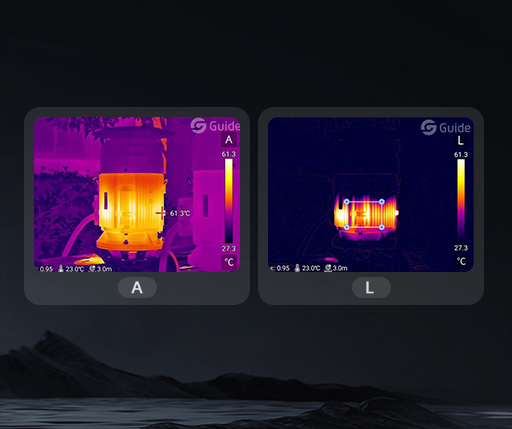
If nine identical circuit breakers show similar temperatures but one shows a noticeably higher temperature or abnormal thermal pattern, the difference is immediately obvious.
Maintenance teams do not need to focus solely on absolute temperatures; instead, they can compare equipment operating under identical loads to identify components with differing operating conditions quickly.
This comparative method enhances detection accuracy while reducing unnecessary testing.
Helping Maintenance Teams Prioritize Tasks
Each inspection may reveal many different maintenance needs, but not all issues require immediate repair.
Thermal imaging technology helps maintenance managers categorize inspection results based on urgency.
For example:
l Equipment with stable thermal patterns can continue to undergo routine monitoring.
l Equipment showing a gradual rise increase in thermal patterns or temperature differences can be scheduled for planned maintenance.
l Equipment exhibiting significant thermal anomalies can be prioritized for repair.
This structured method helps maintenance teams allocate manpower and resources more effectively.
Establishing Unified Inspection Standards
Inspection quality often depends on the individual experience of technicians.
By providing visual temperature records rather than relying solely on written documentation, thermal imaging technology helps standardize the inspection process.
Teams can establish consistent inspection procedures, such as:
l Scanning equipment from the same angle
l Using the same temperature range
l Comparing images under similar operating conditions
l Using a standardized reporting format
These practices make inspection results easier to compare across different maintenance teams and inspection cycles.
Enhancing Team Collaboration
Substation maintenance usually involves multiple departments, including electrical engineers, maintenance technicians, and asset managers.
Thermal images offer a common visual reference that everyone can understand.
Inspectors do not need to depend solely on text descriptions to explain issues; instead, they can share thermal images that visually demonstrate the location and severity of temperature differences.
This not only improves communication but also enables teams to make maintenance decisions more quickly.
Establishing Digital Maintenance Records
Modern industrial thermal imaging cameras can automatically save images, temperature data, inspection times, and equipment information.
These digital records enable maintenance teams to create a complete inspection history for each critical asset.
Historical thermal images can be used to:
l Compare equipment conditions over months or years
l Evaluate the effectiveness of completed repairs
l Monitor equipment aging
l Support maintenance audits
Digital records also streamline reporting and asset management processes.
Providing Training Support for New Maintenance Personnel
Experienced inspectors can often identify equipment anomalies based on experience.
However, new technicians may struggle to detect early warning signs.
Thermal imaging technology simplifies training by visualizing temperature differences as intuitive images.
By studying actual inspection cases, new maintenance personnel can quickly grasp the characteristics of equipment in its normal state and understand how abnormal thermal distribution patterns develop.
This shortens the learning curve and helps improve consistency in inspection work across the entire maintenance team.
Conclusion
Thermal imaging technology effectively enhances substation maintenance efficiency by accelerating inspections, prioritizing maintenance tasks, standardizing inspection workflows, and fostering collaboration. Thermal imaging cameras used in substation maintenance not only help identify abnormal thermal conditions but also enable maintenance teams to improve inspection efficiency throughout the maintenance process.
As substations continue to modernize, thermal imaging technology will play an increasingly important role in establishing smarter, safer, and more efficient maintenance practices.


.svg)
.svg)