








Thermal Insight
for Comfort Life
Thermal Imaging Solutions for HVAC Applications
Overview
HVAC systems are essential to ensuring indoor comfort and energy efficiency in modern buildings. From underfloor heating pipes embedded beneath floors and intricate air-conditioning networks to radiators throughout buildings and district heating pipelines extending for kilometers, these concealed and complex systems are vulnerable to leaks, blockages, and insulation failures. Left undetected, such issues can not only result in significant energy waste, but can also lead to serious consequences such as neighborhood disputes, road collapses, and heating supply interruptions.
Thermal imaging technology offers unique advantages, including rapid large-area scanning, non-destructive inspection, and visualization of subtle temperature differences, making it possible to instantly identify underground pipeline leaks, the layout of concealed wall piping, and areas of heat loss in heating networks. As a result, thermal imaging provides a scientific and efficient solution for HVAC system installation verification, routine maintenance, and energy efficiency improvements.
Thermal imaging technology offers unique advantages, including rapid large-area scanning, non-destructive inspection, and visualization of subtle temperature differences, making it possible to instantly identify underground pipeline leaks, the layout of concealed wall piping, and areas of heat loss in heating networks. As a result, thermal imaging provides a scientific and efficient solution for HVAC system installation verification, routine maintenance, and energy efficiency improvements.
Underfloor Heating Pipe Leak Detection
Background
Underfloor heating pipes are embedded beneath concrete floors and may develop leaks over time due to aging, corrosion, or other factors. Once a leak occurs, it can cause damp floors and warped wooden flooring, In severe cases, it can damage the neighboring unit below and lead to compensation disputes; repairs require breaking up the floor, which is costly and disrupts daily life.
Pain Points
- Leakage points are completely concealed beneath the floor and cannot be identified through visual inspection.
- Traditional leak detection requires extensive floor demolition and point-by-point investigation, resulting in significant disruption and damage.
- Repairs often involve excavating the wrong location, leading to repeated floor opening and substantial waste of time and cost.
.jpg)
.jpg)
Solution
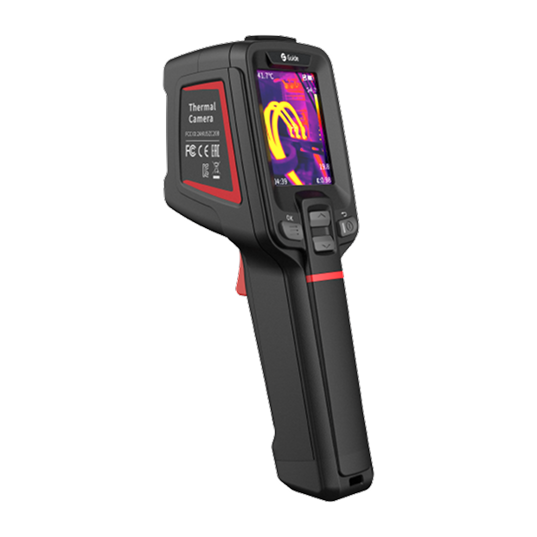
Handheld thermal cameras enable fast and comprehensive inspection of underfloor heating systems. As hot water flows through the pipes, it creates a distinct thermal pattern on the floor surface that contrasts with the surrounding areas. Thermal imaging clearly visualizes the routing of concealed pipes. When a leak occurs, evaporative cooling caused by accumulated moisture produces localized thermal anomalies, allowing leakage points to be identified quickly and accurately.
Non-destructive inspection: Precisely locates leaks without extensive floor demolition, requiring only localized excavation at the leakage point.
Precise localization: Thermal images clearly reveal both the pipe routing and the leak location, eliminating unnecessary excavation.
Time and cost savings: Significantly reduces repair time and maintenance costs.
Air Conditioning System Inspection
Background
Central air conditioning systems and split air conditioners are among the largest energy consumers in buildings, with their heat exchange efficiency directly affecting cooling/heating performance and operating costs. Over time, issues such as fouled heat exchangers, refrigerant leaks, damaged insulation, and blocked piping can occur. These problems not only increase energy consumption but also reduce cooling/heating efficiency and shorten compressor service life.
Pain Points
- Refrigerant leaks are difficult to locate, while conventional leak detection methods are inefficient and provide limited coverage.
- The severity of faults such as heat exchanger fouling cannot be assessed intuitively.
- Energy losses often go unnoticed.
.png)
.jpeg)
Solution
Thermal cameras enable comprehensive inspection of air conditioning systems. By scanning the surface temperature distribution of heat exchangers, areas affected by fouling can be easily identified through abnormal thermal patterns. Refrigerant pipes and fittings can also be inspected, with leakage points appearing as localized cold spots due to evaporative cooling. In addition, thermal imaging can detect duct insulation layer, where temperature differences at damaged areas are clearly visible
Inspection without downtime: Perform comprehensive inspections while the air conditioning system remains in operation.
Comprehensive fault diagnosis: Simultaneously detects multiple issues, including heat exchanger fouling, refrigerant leaks, and damaged insulation.
Improved energy efficiency: Eliminates energy performance losses, reduces operating costs, and extends equipment service life.
Radiator Inspection
Background
Radiators are essential terminal heat-emitting devices for winter heating and are widely used in residential buildings. Problems such as internal scaling and blockage, air locks that restrict water circulation, undersized connection pipes, and insufficiently opened valves can all result in poor heating performance.
Pain Points
- Manual assessment relies heavily on experience, resulting in strong subjectivity and potential errors.
- The locations of blockages or air locks are difficult to accurately identify.
- Point-by-point inspection across large residential communities is inefficient, and objective evidence is often lacking for resolving heating disputes.
.jpeg)
.jpeg)
Solution
Thermal cameras can be used to inspect radiators and connecting pipes as a complete system, clearly visualizing the overall temperature distribution. Under normal conditions, radiators exhibit a uniform temperature pattern. Areas affected by blockages or air locks appear as low-temperature zones due to insufficient hot water circulation, making them easily identifiable on thermal images. Thermal imaging also enables intuitive comparison of heating performance among radiators in different rooms, providing data support for heating system balancing and adjustment.
Visualized quantification: Thermal images clearly display temperature distribution, replacing subjective “touch-based” assessments with objective measurement.
Precise diagnosis: Quickly locates blockages and air locks to guide targeted maintenance.
Heating balance optimization: Compares temperature differences among radiators to support hydraulic balancing adjustments.
District Heating Pipeline Inspection
Background
District heating networks are a vital infrastructure component of modern cities, extending tens or even hundreds of kilometers to deliver heat from energy sources to residential and commercial users. Buried heating pipelines are exposed to high temperatures, high pressure, and soil corrosion over long-term operation. Issues such as damaged insulation, pipeline corrosion and leakage, and joint cracking are difficult to identify through surface observations alone.
Pain Points
- Buried pipelines are located underground and their condition cannot be visually assessed.
- Traditional inspection methods require extensive excavation, causing significant disruption to traffic and public life.
- Heat losses caused by damaged insulation often remain unnoticed over the long term.
.jpeg)
Solution
Handheld thermal cameras can be used to inspect road surfaces above district heating pipelines. Inspections are recommended during early morning or nighttime when traffic is lighter and ambient temperatures are lower, as the temperature difference between the road surface and the pipelines is maximized, ensuring optimal detection results. Thermal imaging clearly reveals the heat distribution patterns of buried heating pipelines, enabling rapid localization of leakage points and damaged insulation areas.
Non-destructive inspection: Locates pipeline leakage points without excavation.
Rapid large-area screening: A single scan covers hundreds of meters of pipeline.
Energy saving and loss reduction: Identifies damaged insulation in time to minimize heat loss.

.png)
.png)