








Can You See Gas Emissions with Thermal Cameras
Release Time 2026-06-18
The emission of gases is a major concern for many industries, such as oil and gas, chemicals, manufacturing, and environmental protection. Many harmful gases are colorless and odorless, making them invisible to the naked eye.
So, can a thermal camera actually detect gas emissions?
The answer is yes - but only certain types of thermal cameras can detect specific gases. While standard thermal cameras are designed to measure surface temperatures, cameras specialized for gas detection utilize advanced infrared technology to visualize certain gas emissions in real time.
Understanding the difference between the two helps businesses choose the right equipment for safety inspections and environmental monitoring.
Standard Thermal Cameras vs. Gas Detection Thermal Cameras
Standard thermal cameras detect infrared radiation emitted by objects and display temperature differences.
They are best suited for detecting:
l Overheating electrical equipment
l Mechanical faults
l Heat loss in buildings
l Insulation defects
l Abnormal temperature distributions
However, standard thermal imaging cameras cannot directly visualize gas clouds.
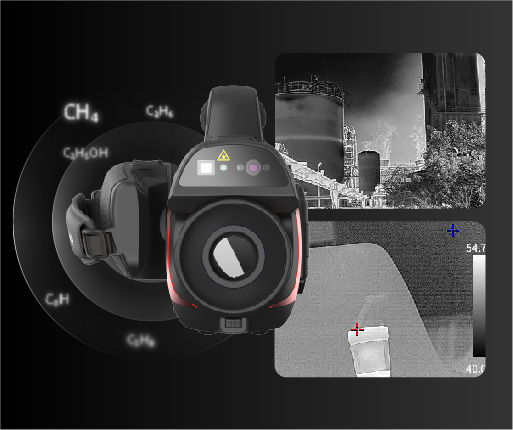
In contrast, gas detection thermal imaging cameras are equipped with specialized infrared sensors that respond to the specific absorption characteristics of certain gases, allowing operators to visualize gas leaks that are otherwise invisible to the naked eye.
How Does a Gas Detection Thermal Camera Work?
Different gases absorb infrared energy at different wavelengths.
A VOCs detection thermal camera or optical gas imaging (OGI) camera is designed to detect these specific wavelengths.
When gas leaks into the air, the camera captures the difference between the gas cloud and the surrounding background, generating a visible image that highlights the leak point.
This allows inspectors to quickly locate the source of the emission without physical contact.
Which Gas Emissions Can be Detected?
Depending on the thermal camera's design, thermal imaging technology is used to detect a variety of industrial gas emissions.
Common detectable gases include:
l Methane
l Benzene
l Propane
l Ethylene
l Ammonia
l Certain volatile organic compounds (VOCs)
Many industrial facilities use thermal cameras for VOC leak detection to monitor equipment and reduce environmental emissions.
Specific detection capabilities depend on the infrared spectral range and the type of gas.
Applications in Industrial Safety
Gas leaks can pose safety hazards, lead to environmental pollution, and result in product loss.
Gas detection thermal cameras assist maintenance teams in industrial inspections by helping them check the following equipment:
l Pipelines
l Valves
l Storage tanks
l Compressors
l Flanges
l Chemical production equipment
Since inspections can usually be performed from a safe distance, the risk of personnel exposure to hazardous environments is reduced.
This not only increases workplace safety but also improves inspection efficiency.
Supporting Environmental Compliance
Many industries are required to comply with environmental regulations regarding atmospheric emissions.
By using thermal imaging cameras to monitor gas leaks, businesses can detect leaks earlier and repair equipment before emissions increase.
Regular inspections help to:
l Reduce VOC emissions
l Improve environmental performance
l Minimize product loss
l Support compliance requirements
l Strengthen sustainability efforts
Early detection of issues benefits both operational efficiency and environmental protection.
Rapid, Non-Contact Leak Detection
Traditional gas detection methods usually require technicians to inspect equipment point by point.
Gas detection thermal cameras can scan large areas quickly and identify potential emission sources without requiring direct contact.
This is especially applicable to the following facilities:
l Petrochemical plants
l Oil refineries
l Natural gas facilities
l Chemical plants
l Energy production sites
Non-contact inspection saves time and improves overall inspection efficiency.
Understanding the Limitations
While gas detection thermal cameras are powerful tools, they cannot detect every gas.
Detection depends on factors such as:
l Gas type
l IR absorption characteristics
l Environmental conditions
l Camera sensitivity
l Background temperature contrast
Additional gas sensors or analytical instruments may still be required for certain hazardous gases.
Thermal imaging should be viewed as part of a comprehensive gas monitoring strategy, rather than the sole detection method.
Conclusion
Can thermal imaging cameras detect toxic emissions? The answer is that it depends on the camera being used. While standard thermal imaging cameras cannot directly visualize toxic gases, specialized gas detection thermal cameras utilize advanced infrared technology to detect and visualize leaks of specific gases.
For industries that prioritize safety, environmental protection, and preventive maintenance, gas detection thermal cameras offer a rapid, non-contact, and efficient solution for identifying invisible emissions before they escalate into major risks.


.svg)
.svg)