








Thermal Imaging Camera for Water Leaks: A Smart Tool for Non-Destructive Inspection
Release Time 2026-05-08
Water leaks can cause severe damage to residential, commercial, and industrial structures. The challenge lies in the fact that many leaks are concealed behind walls, beneath floors, or within ceilings, making them difficult to pinpoint accurately. Traditional detection methods often require drilling or the removal of materials to locate the source of the problem.
A thermal imaging camera for water leaks provides an intelligent and non-destructive solution. By detecting temperature differences caused by moisture, the camera enables inspectors to quickly pinpoint concealed leaks without damaging the building's structure.
Why Hidden Water Leaks Are a Serious Problem
Not all leaks are immediately visible. In many cases, water slowly spreads within walls or floors until visible signs finally appear.
Common problems caused by hidden leaks include:
l Mold growth
l Wall and ceiling damage
l Structural deterioration of the building
l Spiking water bills
l Electrical safety hazards
If leaks are not detected early, repair costs can increase significantly.
How Thermal Imaging Cameras Detect Water Leaks
A thermal imaging camera for leak detection works by capturing infrared radiation and converting temperature differences into visible thermal images.
When water seeps into construction materials, it alters the temperature of the affected areas. For instance:
l Wet surfaces may appear cooler due to evaporation
l Water behind walls can create unusual thermal patterns
l Leaking pipes may generate localized hot or cold spots
These temperature changes become visible on the thermal image, helping inspectors identify hidden moisture intrusion.
Advantages of Non-Destructive Testing
One of the greatest advantages of using thermal cameras for leak detection is the ability to perform non-destructive testing.
Inspectors can achieve the following without extensive demolition of walls or floors:
l Rapidly scan surfaces
l Precisely pinpoint problem areas
l Minimize unnecessary damage
This is not only time-saving but also reduces repair costs.
A More Efficient Leak Detection Process
Traditional leak detection methods are often time-consuming, particularly in large buildings. Portable thermal cameras provide immediate visual feedback, thereby significantly accelerating the detection process.
Technicians can quickly inspect the following areas:
l Walls and ceilings
l Floor and pipelines
l HVAC systems
l Roof structures
Fast detection means repairs can begin sooner, reducing the spread of water damage.
Enhancing Leak Detection Accuracy
Without the right tools, pinpointing the exact source of a leak can be challenging. High-resolution thermal imaging cameras clearly reveal areas of abnormal temperature, thereby significantly enhancing detection accuracy.
This enables inspectors to:
l More precisely identify concealed moisture
l Minimize false positives and unproductive inspections
l Precisely focus repair efforts on the correct location
Improved detection accuracy leads to more efficient maintenance operations.
Applications in Residential and Commercial Buildings
Water leak thermal imaging cameras can be utilized in a wide range of environments, including:
l Residential homes and apartments
l Office buildings
l Hotels and shopping centers
l Industrial facilities
They are widely used for the following purposes:
l Pipe leak detection
l Roof leak inspection
l Internal wall moisture analysis
l HVAC leak detection
Due to their flexibility, thermal imaging cameras are highly valuable tools for plumbers, contractors, and building inspectors.
Supporting Preventive Maintenance
Thermal imaging technology is useful not only after a leak occurs but also supports preventive maintenance by identifying moisture issues at an early stage.
Routine inspections can be used to:
l Prevent long-term structural damage
l Reduce emergency repair costs
l Enhance building safety
l Extend the service life of facilities
Detecting problems early is always more cost-effective than undertaking extensive repairs.
Easy and Safe to Use
Modern handheld thermal imaging cameras are lightweight and easy to operate. Many models include:
l Real-time thermal imaging
l Image capture and report generation
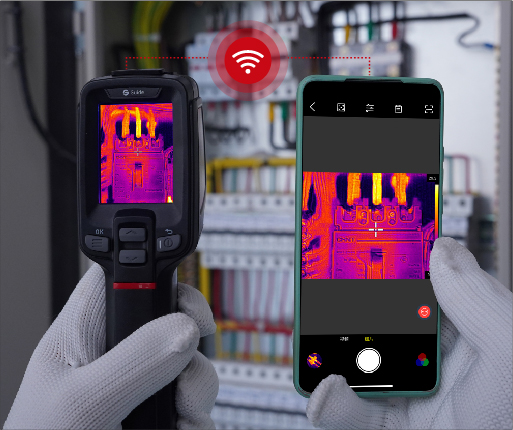
l Mobile app connectivity
l Temperature analysis tools
Since the inspection process is non-contact, it also offers enhanced safety when conducting inspections near electrical systems or in hard-to-reach areas.
Conclusion
Thermal imaging cameras are intelligent and efficient tools for the non-destructive detection of water leaks. By leveraging temperature differences to identify concealed moisture, they enable inspectors to quickly pinpoint leak sources without causing damage to walls or floors.
With benefits such as faster inspections, improved accuracy, and reduced repair costs, thermal imaging cameras for water leaks are becoming essential tools in modern building maintenance and inspection work.


.svg)
.svg)